Account-based marketing email examples: four we wrote, taken apart
Four account-based emails we wrote, shown as sent: an introduction, an account approach, a follow-up and a referral. What each does, and when not to use it.
56 to 136
Contents
An account-based email opens with something true and specific about one company, asks for one small thing, and is written for one person to answer. A template with a first name merged into the greeting does none of that. Here are four Draftship templates, rendered as sent and taken apart.
If you have not chosen your accounts yet, start with how to build a target account list. Before the bodies, here is what the reader sees first.
Mara Okafor
A question about your Monday reporting
One question, and I will get out of your inbox either way.
Names the reader's own routine and promises one question. Nothing about the sender or the product.
Joel Ferreira
Two warehouses and the quarterly close
The part that hurts is not the migration, it is the reconciliation in January.
Two nouns from the account's world. It reads as a topic, with no question and no pitch.
Mara Okafor
Re: A question about your Monday reporting
Closing the loop, and I will stop after this one.
“Re:” because it is a reply in the same thread. The preview says it is the last one.
Ines Duarte
Probably the wrong person
Two lines you can forward to whoever actually owns this.
Admits the mismatch first, so opening it costs the reader nothing.
The shortest first touch: one true line and one ask
Read it as text
Subject A question about your Monday reporting
Hi Tomas,
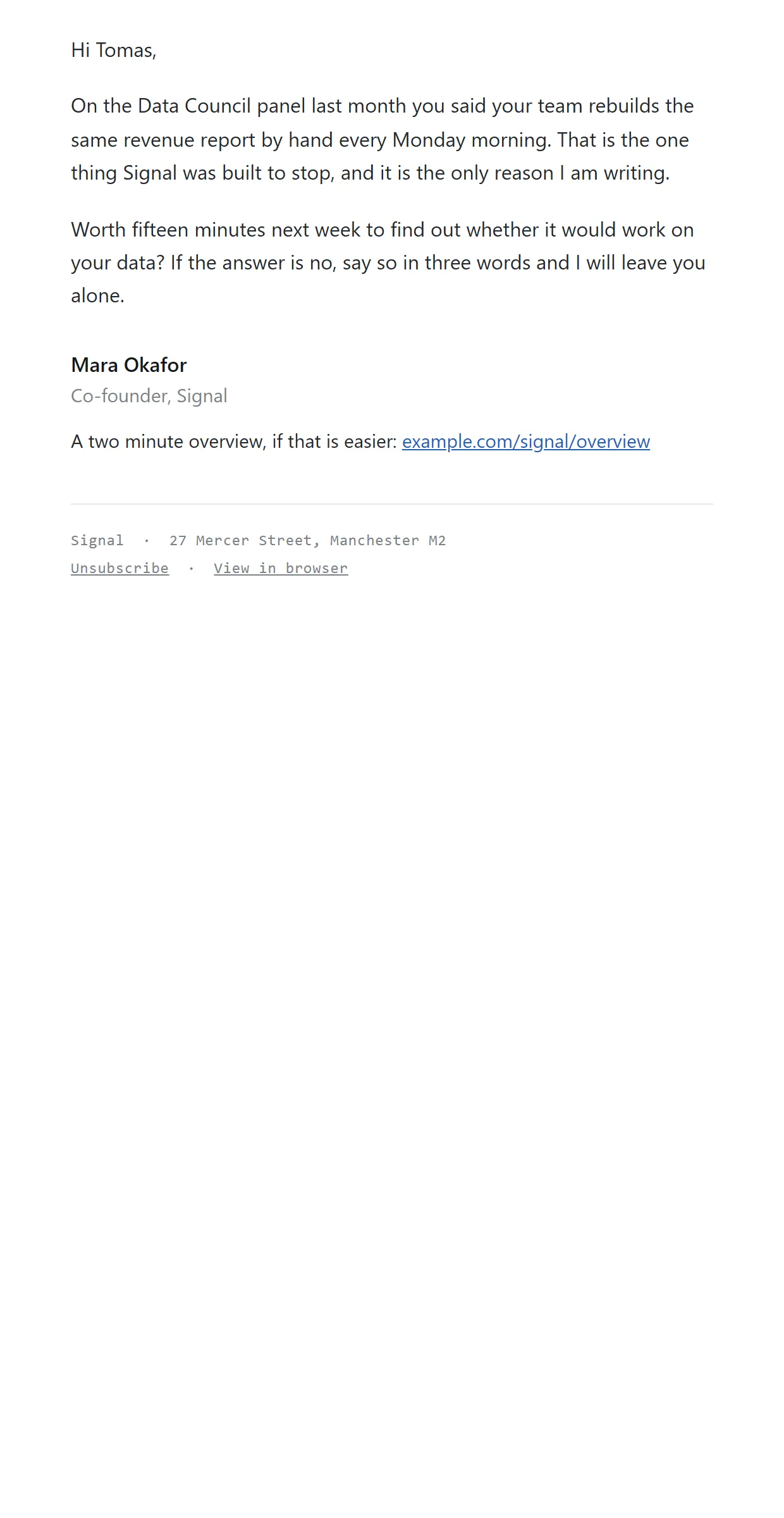
On the Data Council panel last month you said your team rebuilds the same revenue report by hand every Monday morning. That is the one thing Signal was built to stop, and it is the only reason I am writing.
Worth fifteen minutes next week to find out whether it would work on your data? If the answer is no, say so in three words and I will leave you alone.
Mara Okafor
Co-founder, Signal
A two minute overview, if that is easier: example.com/signal/overview
Signal · 27 Mercer Street, Manchester M2 Unsubscribe · View in browser
Signal · Cold introduction, 71 words in two paragraphs.
- The first sentence is the research. "On the Data Council panel last month you said your team rebuilds the same revenue report by hand every Monday morning." It points at a public, dated moment, and a person rewrites it for each recipient.
- One sentence of pitch, then one ask with an exit: "fifteen minutes next week", or a no that costs "three words".
- One link, in the signature, offered as the easier route. No attachment, deck or calendar link.
Change the panel sentence to one fact from a dated public source, and keep the link in your notes. Skip it when you could not show the reader where your opening line came from, or when they said it in private: quoting it tells them they were watched.
The longer first touch to a named account
Read it as text
Subject Two warehouses and the quarterly close
Hi Tomas,
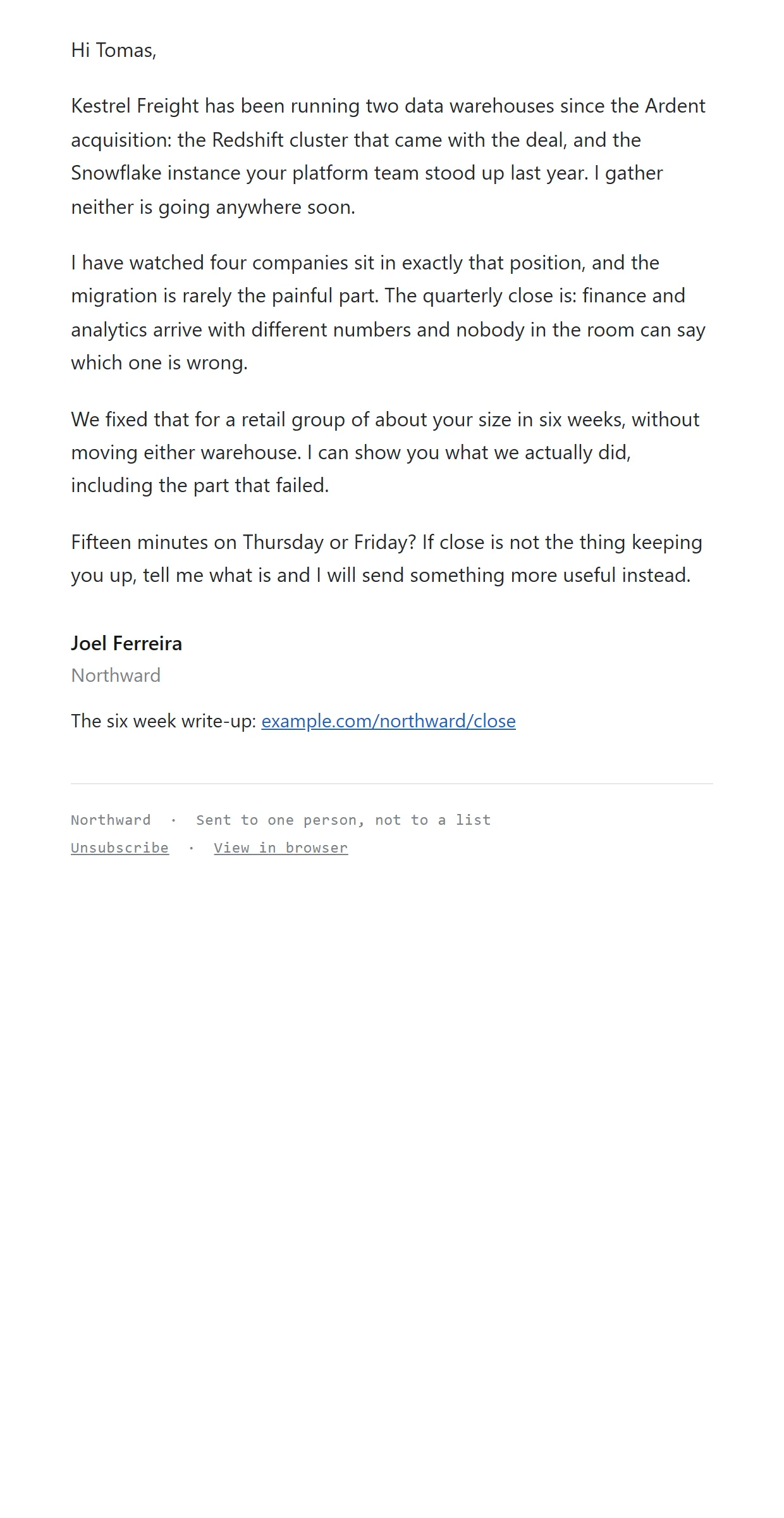
Kestrel Freight has been running two data warehouses since the Ardent acquisition: the Redshift cluster that came with the deal, and the Snowflake instance your platform team stood up last year. I gather neither is going anywhere soon.
I have watched four companies sit in exactly that position, and the migration is rarely the painful part. The quarterly close is: finance and analytics arrive with different numbers and nobody in the room can say which one is wrong.
We fixed that for a retail group of about your size in six weeks, without moving either warehouse. I can show you what we actually did, including the part that failed.
Fifteen minutes on Thursday or Friday? If close is not the thing keeping you up, tell me what is and I will send something more useful instead.
Joel Ferreira
Northward
The six week write-up: example.com/northward/close
Northward · Sent to one person, not to a list Unsubscribe · View in browser
Northward · Account approach, 136 words. Each paragraph has one job: a fact, the problem it causes, evidence, the ask.
- The first sentence stacks checkable facts: two warehouses, an acquisition, the cluster that came with it. "I gather neither is going anywhere soon" flags the rest as inference.
- The merge tag marks where the research starts.
{{company|Your team}}fills in a name, but the detail after it differs for every account, so a person writes it. - The ask turns a no into information: "tell me what is and I will send something more useful instead."
Change the whole first paragraph, and replace the retail-group sentence with a case you can document, or delete it. Replace the footer line with your postal address: the FTC's CAN-SPAM guide requires one and makes no exception for business-to-business email. Skip it when your first paragraph could describe any company on your list, or when you would send it to five people at one account, since colleagues compare inboxes.
The second email, sent once
Read it as text
Subject Re: A question about your Monday reporting
Hi Tomas,
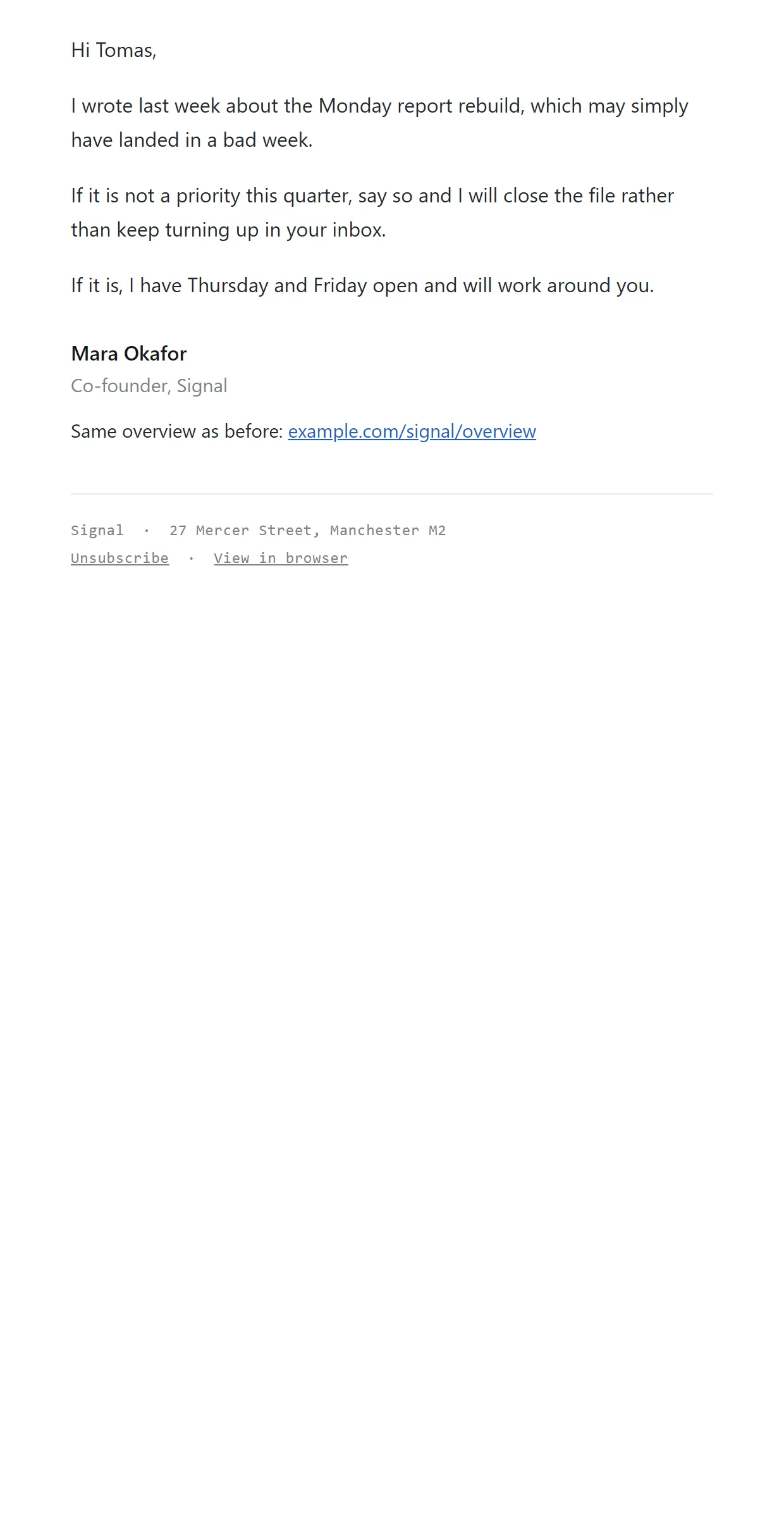
I wrote last week about the Monday report rebuild, which may simply have landed in a bad week.
If it is not a priority this quarter, say so and I will close the file rather than keep turning up in your inbox.
If it is, I have Thursday and Friday open and will work around you.
Mara Okafor
Co-founder, Signal
Same overview as before: example.com/signal/overview
Signal · 27 Mercer Street, Manchester M2 Unsubscribe · View in browser
Signal · Second email, 56 words, sent in the same thread about a week later.
- It points back without repeating the pitch, and gives the silence a kind reason: it "may simply have landed in a bad week".
- It offers to stop. One line from the reader closes the file.
- It asks for nothing new: the same link, and two days the sender is free.
Send it as a reply in the original thread, so the "Re:" is true. Skip it when the first email got any reply, including an out-of-office, or when it bounced or the reader opted out.
The email that asks for a name instead of a meeting
Read it as text
Subject Probably the wrong person
Hi Tomas,
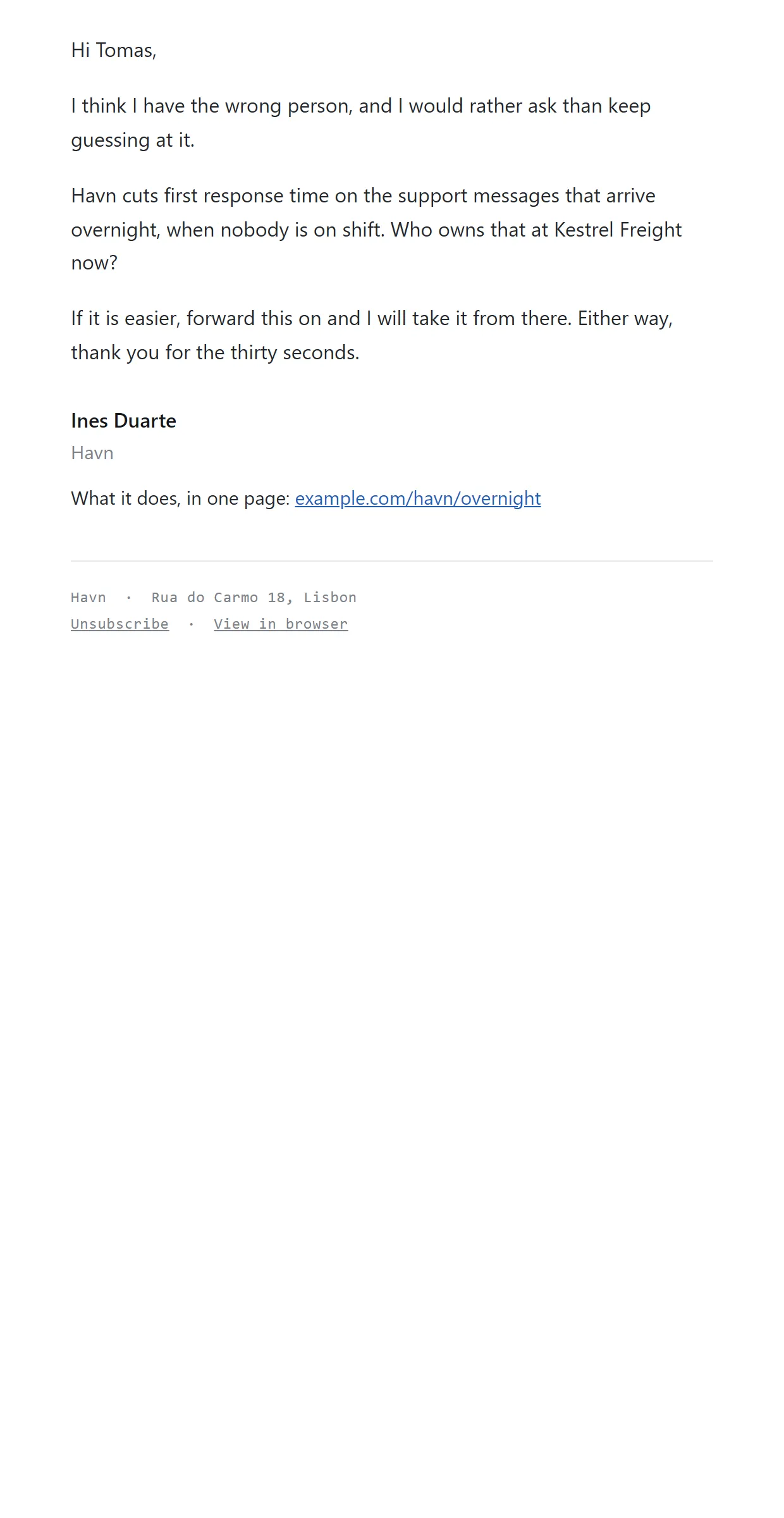
I think I have the wrong person, and I would rather ask than keep guessing at it.
Havn cuts first response time on the support messages that arrive overnight, when nobody is on shift. Who owns that at Kestrel Freight now?
If it is easier, forward this on and I will take it from there. Either way, thank you for the thirty seconds.
Ines Duarte
Havn
What it does, in one page: example.com/havn/overnight
Havn · Rua do Carmo 18, Lisbon Unsubscribe · View in browser
Havn · Pointing me at the right person, 63 words.
- The pitch is one sentence in the problem's terms, so a reader with no view on Havn can tell whether it describes their team.
- The ask is a name. The company tag sits inside the question, where its fallback still reads normally.
- It survives a forward. Each paragraph stands alone, and it closes on thanks without asking for a call.
Change the pitch to a reason this company has the problem, such as published support hours or customers in other time zones. Skip it when you know who owns the problem, or when you are sure this is the right person, since the subject then works only as a trick.
What all four have in common
Cold introduction 71 words
Research 21, pitch 19, ask 15, way out 16
Account approach 136 words
Research 38, problem 40, evidence 31, ask 6, way out 21
Second email 56 words
Points back 18, way out 24, ask 14
Pointing me at the right person 63 words
Admission 17, pitch 17, ask 7, way out 14, thanks 8
Words in the body
- The researched fact
- The ask
- The cheap way out
- Everything else
- 50 to 125 words, Boomerang's best response rates
- One ask, with a cheap way out. In each, the shortest answer takes one line.
- The name lives in the greeting, with a fallback. No subject carries a name, a company, the sender or the product.
- Built to look typed: system font at 16 pixels, no image, button or logo, one link in the signature, and unsubscribe and view-in-browser links in the footer.
Before you send: a checklist
Software can read an annual report for you, but a person checks every fact that reaches the email (why we do not use AI SDRs).
- Write down where the first sentence came from: a link and a date, next to the draft. No source, no send.
- Count the asks. One, plus at most one link that is an easier way to answer it.
- Send from your own authenticated domain. Google asks every sender to set up SPF or DKIM and keep its spam rate below 0.3% (Google's sender guidelines). The free email domain checker reads yours.
- Keep an unsubscribe link and a postal address in the footer, and honor opt-outs within 10 business days, as the FTC guide requires.
- Make the subject tell the truth. The FTC says it must accurately reflect the message, so "Re:" goes only on a reply.
- Test the fallbacks. Send yourself a copy with first name and company empty. "Hi there," passes. "Hi ," does not.
Questions about these examples
How long should an account-based email be?
Long enough to hold a fact, a problem and an ask. Boomerang's study of 40 million emails found response rates above 50% between 50 and 125 words, without saying whether any were sales mail. Our four run from 56 to 136 words.
Should the email be plain text or HTML?
Either, if it reads as typed. HubSpot's tests found that the more HTML-rich an email was, the lower its open rate, and that a single image cut clicks. These four are HTML built to look typed.
How many follow-ups should you send?
More than none, fewer than a drip. In Belkins' study of 7,530,489 emails sent in 2025, steps two to six produced 58.6% of replies, and returns fell fast after step five. On a named list, send the follow-up above once, then change something: a new fact, another person at the account, or another channel.
Can I use these templates for free?
Yes. Each opens in the free editor with no account and exports as HTML: Cold introduction, Account approach, Second email and Pointing me at the right person. The subject line checker shows how a subject is cut off in each mail client. If you would rather have a written plan for your own accounts, tell us what you are trying to fix.
Sources
The outside pages this article links to, once each, and what it cites them for.
- ftc.govReplace the footer line with your postal address: the FTC's CAN-SPAM guide requires one and makes no exception for business-to-business email
- support.google.comGoogle asks every sender to set up SPF or DKIM and keep its spam rate below 0.3%
- blog.boomerangapp.comstudy of 40 million emails
- blog.hubspot.comHubSpot's tests found that the more HTML-rich an email was, the lower its open rate, and that a single image cut clicks
- belkins.ioBelkins' study of 7,530,489 emails
If you want this applied to your own accounts, tell us what you are trying to fix.
Contact us